The 5 Best Dog Training Apps in 2026 — We Put Each One Through a Real Week of Training
Leash pulling, jumping on guests, ignoring “come”… Most dog problems don't need a bootcamp. They need a short, clear plan you'll actually stick with. We compared the most popular dog training apps on exactly that.
STBy The shavethat.com Review Desk · Updated November 6, 2026 · 16 min read
Advertising disclosure: we have a business relationship with Scott & Maple, our #1 pick, and earn money when readers sign up. How this page works.
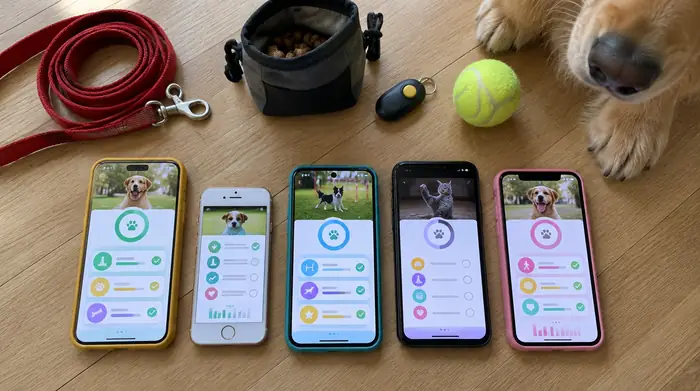
Five phones, five dog training apps, and one very interested golden retriever.
Every dog training app promises a better-behaved dog. Most of them hand you a library of videos and leave the hard part — doing a little every day — up to you. We compared five of the most-used dog training apps to find the one that actually gets you practicing, and one clearly stood out.
Quick picks: the best dog training apps
Scott & Maple — best dog training app overall (personalized 5-minute daily plan)
Dogo — best for tricks and trainer feedback
Puppr — best for video lessons
Woofz — best for problem-specific programs
Zigzag — best for brand-new puppies
How we tested
We set up each app for a real dog and followed it for full training weeks. We scored five things: how well it personalizes to your dog's age and problems, how clear and kind the lessons are, how much time a day it asks for, how it shows progress, and how easy it is to keep going. We also read public app-store reviews and each app's own description.
The criterion we weighted most heavily: does the app turn training into a short daily plan you'll actually stick with? Dogs learn through lots of short, happy repetitions spread over days and weeks. A 200-video library you open twice a month won't get you there. The best dog training app is the one that tells you exactly what to do today, in a few minutes, and makes you want to come back tomorrow.
Editor's Choice
1
Scott & Maple
Best dog training app overall
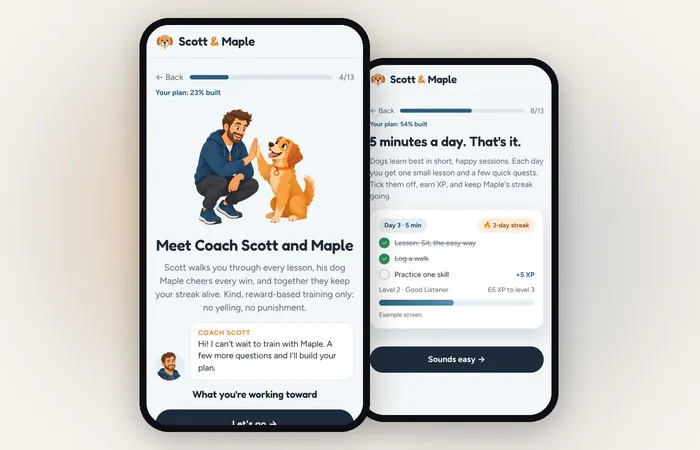
Scott & Maple starts with a short quiz about your dog — age, size, energy and the problems that bug you most (pulling on the leash, jumping, barking, nipping, not coming when called, potty accidents) — and builds a personalized 28-day plan in about 5 minutes a day. Each day unlocks one short lesson with the why, the cue, a session timer and tickable steps, taught by illustrated Coach Scott and his dog Maple. Around it sit a few quick daily quests, XP, levels, a 7-day paw calendar, skill stars and a weekly “wrapped” recap, which made it the easiest app in our test to keep coming back to — exactly what our most-weighted criterion rewards. Methods are reward-based only: no yelling, no punishment.
Pros
Personalized 28-day plan built around your dog's own problems
One 5-minute lesson a day — the most realistic routine we tested
Streaks, XP, badges and weekly recaps keep you consistent
Kind, reward-based methods; every lesson explains the why
Practice and walk log you can export
Cons
Runs in your phone's browser (add it to your home screen) — no App Store download
Newer than the big names, so fewer public reviews so far
Focused on everyday manners rather than a huge trick library
Dogo is one of the most downloaded dog training apps, rated about 4.8 on the App Store from 17,000+ ratings. Its strength is breadth: a library of 100+ tricks and commands with video instructions, a built-in clicker and whistle, and the option to send a short video “exam” to a Dogo trainer for feedback. It's excellent if you want variety — but you mostly decide what to practice and when, so it takes more self-direction day to day.
Pros
100+ tricks with video instructions
Video exams with trainer feedback
Built-in clicker and whistle
Cons
Big library can feel unstructured
Many features sit behind a subscription
3
Puppr
Best for video lessons from a well-known trainer
Puppr (about 4.8 stars from 27,000+ App Store ratings) has 100+ step-by-step video lessons taught by trainer Sara Carson and her Super Collies, from basic obedience to advanced tricks. It adds a weekly puppy guide, masterclasses, live chat with trainers and a built-in clicker. It's a great teacher; like most library-style apps, building a daily routine is largely up to you.
Pros
Polished video lessons, positive reinforcement only
Weekly puppy guide and masterclasses
Live chat with trainers
Cons
Lesson library rather than a day-by-day plan
Trick-heavy if you mainly need manners
4
Woofz
Best for problem-specific programs
Woofz (about 4.6 stars from 58,000+ App Store ratings) builds a personalized training and care plan and offers targeted programs for potty training, leash pulling, barking, chewing, biting and alone time, plus a commands bootcamp and short video lessons. It uses positive reinforcement. It covers a lot of ground — training and everyday care — which is useful, but can feel busier than a simple daily lesson.
Pros
Targeted programs for common problems
Personalized plan
Training and care tools in one app
Cons
Lots of sections to navigate
Less focused on one short daily session
5
Zigzag
Best for brand-new puppies
Zigzag (about 4.8 stars from 4,000+ App Store ratings) is dedicated to puppyhood. It personalizes a puppy program by age and breed, includes 250+ lessons with how-to videos, and lets you message training coaches. If you have a young puppy it's a thoughtful choice; it's less suited to adult dogs with established habits.
Pros
Built specifically for puppies
Program by age and breed
Message training coaches
Cons
Puppy-focused — less for adult dogs
Smaller review base than the leaders
At a glance
Dog training apps compared
App
Daily plan for your dog
Time per day
Progress & streaks
Best for
Platform · rating
Scott & Maple
Yes — personalized 28-day plan
~5 min
XP, streaks, badges, skill stars
Everyday manners
Browser · iPhone & Android
Dogo
Programs + big library
You decide
Yes
Tricks, trainer feedback
iOS / Android · 4.8★ (17k)
Puppr
Library + puppy guide
You decide
Yes
Video lessons
iOS / Android · 4.8★ (27k)
Woofz
Yes — training & care plan
Varies
Yes
Specific problems
iOS / Android · 4.6★ (58k)
Zigzag
Yes — puppy program
Varies
Yes
Young puppies
iOS / Android · 4.8★ (4k)
Based on our hands-on use and each app's public store listing as of November 2026 (ratings from the US App Store). Features change — check each app before you choose.
Part 1
Why a dog training app helps (when it's the right kind)
Most everyday dog problems — pulling, jumping, nipping, ignoring “come” — aren't about a stubborn dog. They're about practice: dogs learn a cue through many short, rewarded repetitions in different places, spread over days and weeks. That's simple in theory and hard to keep up in real life. A good app solves the “real life” part.
One cue, one treat, one tiny session at a time.
1. Short and often beats long and rare
Five focused minutes a day tend to do more than an hour every other weekend. Dogs lose focus quickly, and short sessions end on a win. An app that hands you one small lesson a day makes “often” automatic.
2. You need a plan, not just information
There's no shortage of free training videos. What most owners are missing is an order: what to teach first, what comes next, and when to move on. A step-by-step plan removes the guesswork.
3. Everyone in the house says the same thing
If one person says “down” for “get off the couch” and another means “lie down”, your dog hears noise. A shared plan with the same cue words keeps the whole family consistent.
4. Timing and rewards are a skill — for you
Reward-based training works best when the reward arrives at the exact right moment. Good apps teach the human side too: a marker word, tiny treats, ending on a win.
5. Progress is easy to miss without a record
Improvement is gradual, so it often feels like nothing is changing. A log, skill stars or a weekly recap shows that last week your dog needed three tries for “sit” and this week it's one.
6. It complements a trainer — it doesn't replace one
Apps are great for daily practice between classes or for everyday manners at home. For aggression, fear or anxiety, a certified professional comes first (see what apps aren't).
Part 2
The problem with most dog training apps
Every app on our list teaches with kind, reward-based methods. The difference is whether it gets you practicing. Here's where most fall short in day-to-day use:
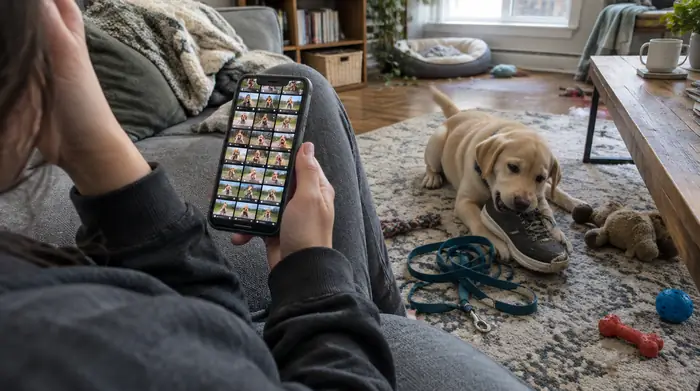
200 videos and a puppy eating your shoe.
01
A library, not a plan
Hundreds of tricks are fun to browse. But “what should we do today?” is the question that matters, and a library makes you answer it yourself every day.
02
Sessions that are too long
If a lesson needs 30 minutes and a quiet afternoon, it happens on Saturdays only. Dogs need little and often.
03
Generic, not your dog's problems
A shy senior and a bouncy teenage lab need different first weeks. One-size programs waste time on what you don't need.
04
No way to see progress
Without a record, small improvements are invisible — and that's when people quit, right before it starts to click.
05
No reason to come back tomorrow
Consistency is the whole game. Streaks, quests and a weekly recap sound small, but they're what make day 12 happen.
GIFIllustration: seven 5-minute sessions add up to 35 minutes of practice — and visible progress.
That's the idea behind Scott & Maple: one short lesson a day, built around your dog's problems, with a streak, XP and skill stars that make the progress visible. It's the main reason it ranks #1 here.
Part 3
What happens without a plan: four everyday examples
Please note: these are illustrative examples — composites of situations dog owners commonly describe. The people, dogs and names are invented. They are not testimonials or endorsements, and they don't describe typical results.
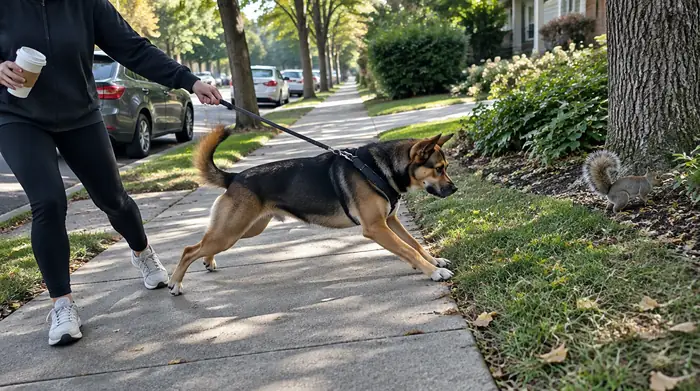
The daily tug-of-war most owners know too well.
Example A · “Sam” and Biscuit
The leash puller
Situation: Sam watched a dozen loose-leash videos and tried a new method on almost every walk.
What went wrong: every technique got one attempt, outdoors, with squirrels — the hardest possible setting. Biscuit never got the easy, repeated practice at home first.
What a plan changes: start with focus games in the hallway, then the driveway, then a quiet street — a few minutes a day, one step at a time, before tackling the squirrel route.
Example B · “Nina” and Rocket
The jumping greeter
Situation: Rocket jumps on everyone at the door. Nina turns away; her partner pets him “just this once”; the kids squeal.
What went wrong: three different reactions means jumping still pays off sometimes — so it keeps happening.
What a plan changes: one shared lesson everyone follows, the same cue word for everyone, and a calm “sit to say hi” practiced in short daily sessions.
Example C · “Theo” and Juniper
The nippy puppy and the 30-minute sessions
Situation: Theo set aside half an hour every evening for puppy training.
What went wrong: Juniper was overtired and mouthy by minute ten, so sessions ended in frustration for both of them.
What a plan changes: 3–5 minute sessions that end on a win, plus calm-settle practice — short enough to fit a puppy's attention span.
Example D · “Rosa” and Pepper
The dog who only “comes” at home
Situation: Pepper's recall is perfect in the kitchen and nonexistent at the park.
What went wrong: recall was only practiced when it mattered — never in gradually harder places, and “come” sometimes meant the fun was over.
What a plan changes: recall games that always pay well, moved step by step from the kitchen to the yard to the park, logged so you know when to level up.
Part 4
When to start using a dog training app
The best time is before a habit sets in — but it's never too late. Dogs of every age learn with reward-based training. These moments matter most:
The week a puppy comes home. Name, marker word, potty routine and gentle handling are easiest to build from day one.
The “teenager” phase (about 6 months to 2 years). Many dogs test boundaries and forget cues they knew. Short daily practice gets you through it.
When a new habit appears. Pulling, jumping or barking at the door gets harder to change the longer it's rewarded.
After a big change. A move, a new baby, a new pet or a new schedule is a good moment to refresh the basics.
When you adopt an adult or rescue dog. Start gently with name, sit and settle while they get to know you. Give a nervous dog time and space.
When an old skill slips. A short refresher plan brings it back faster than starting from scratch later.
Before an exciting season. Holidays with guests, summer at the park, a first trip — practice the skills you'll need ahead of time.
Part 5
How to use a dog training app: the 5-minutes-a-day routine
You don't need hours. Here's the simple routine we recommend after testing all five apps:
1
Set it up once (about 2 minutes)
Tell the app about your dog: age, size, energy and what you'd love to fix first. In Scott & Maple this is a short quiz with Coach Scott.
2
Every day: one 5-minute lesson
Same time each day, tiny soft treats ready, phone timer on. Stop while your dog still wants more.
3
Sprinkle practice into real life
Ask for a sit before meals, a wait at the door, a hand target on walks. Ten seconds here and there counts.
4
Log walks and wins
A quick note on how it went shows you what's improving and what needs an easier step.
5
Once a week: look back
Check skill stars or your weekly recap. Level up the skills that are easy now; go back a step on the ones that aren't.
GIFScreen recording: Scott & Maple's setup quiz.
Five minutes, a handful of tiny treats, done.
Tips that make training stick
Tiny, soft treats. Pea-sized, so you can do lots of reps without filling your dog up.
One cue, one word. Pick your words once and get everyone in the house to use them.
End on a win. If it falls apart, ask for something easy, reward it, and stop.
Easy places first. Practice at home before the park. Add distractions slowly.
Watch your dog's body language. Yawning, turning away or freezing can mean stress — take a break and make it easier.
Important
What a dog training app is NOT
Training apps are useful tools, but it's important to be clear about what they don't do — including Scott & Maple and every other app on this page:
✕ Not a vet
Apps give general training education. They don't diagnose or treat anything. Sudden behavior changes can have a medical cause — check with your veterinarian.
✕ Not a behaviorist
For aggression, biting, fear or severe anxiety, work with a qualified professional such as a veterinary behaviorist or a certified trainer — not an app.
✕ Not a guarantee
No app can promise results. Every dog learns at their own pace, and progress depends on consistent practice.
✕ Not a substitute for supervision
Keep your dog safe while training: use a leash where required, supervise around kids and other animals, and follow local rules.
✕ Not punishment-based
Every app we recommend uses reward-based methods. We don't recommend tools or techniques that rely on pain, fear or intimidation.
✕ Not a live trainer by default
Some apps offer chat or video feedback from trainers; others, including Scott & Maple, use illustrated coach characters. Check what's included before you subscribe.
✕ Not free forever
Most of these apps are subscriptions that renew automatically. Read the price, renewal terms and refund policy at checkout, and cancel anytime you need to.
✕ Not affiliated with each other
Dogo, Puppr, Woofz and Zigzag are trademarks of their owners. None of them sponsors or endorses this page.
FAQ
Dog training app questions, answered
What is the best dog training app?
In our testing, Scott & Maple is the best dog training app for most people because it builds a personalized 28-day plan around your dog's own problems and keeps it to about 5 minutes a day, with streaks and skill stars that make it easy to stick with. Dogo is a strong alternative if you want a big trick library and trainer feedback.
How much does Scott & Maple cost?
The quiz is free. Scott & Maple's plans are paid subscriptions; the “50% off” button applies its introductory offer for the first billing period. Plans renew automatically at the regular price unless you cancel, and Scott & Maple offers a 30-day money-back guarantee. Check the current price and terms on its checkout page before you subscribe.
Does Scott & Maple work on iPhone and Android?
Yes. It runs in your phone's browser, so there's nothing to download, and you can add it to your home screen so it opens like an app.
Is it for puppies or adult dogs?
Both. The quiz asks your dog's age, from puppy to senior, and the plan adjusts. If you have a very young puppy, Zigzag is also worth a look.
How long does it take to see progress?
It depends on your dog, the skill and how consistently you practice. Many owners notice small improvements within the first couple of weeks of short daily sessions, but there's no guaranteed timeline.
Can an app fix aggression or severe anxiety?
No. For aggression, biting, fear or severe anxiety, please talk to your veterinarian and a qualified behavior professional. Apps are for everyday manners and practice.
Do I need a clicker?
No. A short marker word like “Yes!” works just as well. Some apps include a built-in clicker if you prefer one.
The bottom line
All five apps teach with kind, reward-based methods. Dogo is great for tricks and trainer feedback, Puppr for polished video lessons, Woofz for problem-specific programs, and Zigzag for brand-new puppies. But if what you need is a plan built around your dog that fits into 5 minutes a day — and a reason to actually do it tomorrow — Scott & Maple is our pick for the best dog training app. Start with its free quiz.